The wizard of Oz at Sphere
(2025) Lead Colorist
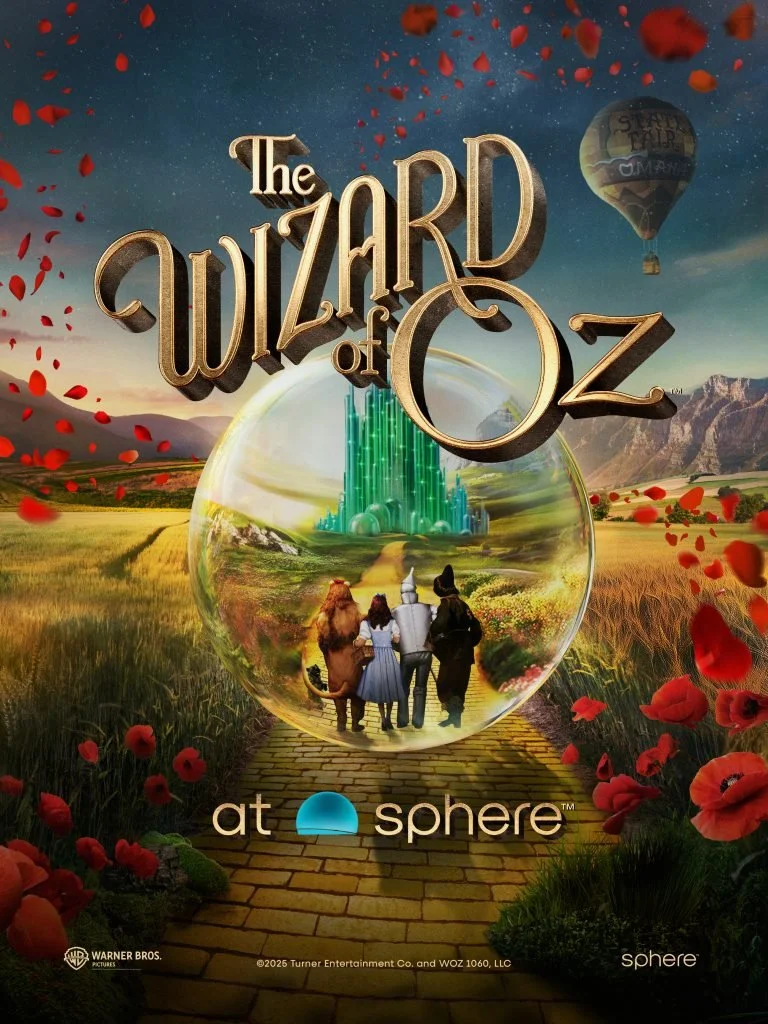
Grading the 1939 classic for the largest screen ever built.
Intro
Bringing The Wizard of Oz to Sphere meant re-imagining a film shot nearly a century ago for a cinema screen, on a canvas of 160,000 square feet. As lead colorist, I worked to keep the character of the original, that unmistakable Technicolor warmth, while adapting it for a format its filmmakers could never have imagined.
The challenge of scale
Every decision had to hold up at true size. A matte edge that reads clean on a reference monitor can show up as a hundred-foot flaw on the media plane. Color that feels balanced at normal viewing distance can shift in saturation and brightness once it's wrapped around an audience.
Technicolor made that harder. On a dome, bright or saturated images at the top of the screen spill light onto the screen in front of you, lifting the blacks and washing out the color. A few scenes in Oz have bright blue skies, so in those we added contrast and brought the gamma down on the front of the screen to keep the look consistent across the whole dome.
The Technicolor moment
The most famous moment in the film is Dorothy stepping out of sepia Kansas into the color of Oz. In 1939 it was pure magic, and we had to make it feel just as magical at Sphere.
It took many tests to get right. We had to balance not just the saturation of the incoming color, but its brightness too: a sudden burst of bright, saturated color fills the dome with light and spills back across the screen through cross talk. Getting that transition to land took careful work on both color and cross talk, so the reveal hits the audience the way it hit audiences in 1939.
16K finished resolution
Baselight X
60 cloud render nodes
1.3PB graded images per week
graded on 40,000 sq ft screen
16K finished resolution Baselight X 60 cloud render nodes 1.3PB graded images per week graded on 40,000 sq ft screen
Behind the grade
Our approach was anything but conventional. Grading a 16K image meant rethinking the whole finishing pipeline, not just the color.
In the suites We ran several FilmLight Baselight X systems side by side, grading from 4K proxies on fast local SSD storage, with the full 16K files held across cloud and on-premises storage. Each suite was set up with Sony X310 reference monitors.
In Big Dome The real test came in Big Dome, our quarter-scale version of Sphere in Burbank, with a 40,000 sq ft media plane of its own. That's where we held our final color reviews and set the color for the film's new scenes.
In the cloud In the six weeks before the premiere, we rendered an average of 1.3 petabytes of graded files every week, using 60 Baselight render nodes in the cloud. Every version went out to Big Dome and to Sphere in Las Vegas for review, and it all landed in time for opening night.